
Showing posts with label rolls. Show all posts
Showing posts with label rolls. Show all posts
November 23, 2010
Park it Right Here for a Better Roll Recipe

October 14, 2010
The Road to Kolache Heaven
POLKA DAY IN NEBRASKA
I didn't really think about featuring the Kolache as Nebraska's dessert until I was browsing my newest cookbook: "United Cakes of America" by Warren Brown. This wonderful cookbook is mandatory reading for our journey. Warren, who has bake shops on the East Coast, has put together a national treasury of desserts that's also an entertaining history of baking in America. Plus, it's one of the very few cookbooks that organizes recipes by state. (So if any publishing houses want to explore this idea of more regional/state cooking themes, feel free to contact me.)
For Nebraska, Warren presented a kolache recipe, but I thought it would be a crime not to feature MY OWN GRANDMOTHER'S RECIPE. She lived and baked 13 miles from the southern border of Nebraska, in the small town of Cuba, Kansas.

Cuba's got a strong Czech heritage and I remember once singing a happy Czech song in a skit with two other little preschool friends in front of lots of people laughing. I cannot remember WHAT we were singing, but it was probably about food. I think the older lady on stage with us had a bucket of lard. But maybe I'm getting mixed up. It was a long, long time ago. But the Senior Citizen's Community Center had a stage backdrop that was a painting of a Czech street scene. I'm not sure what condition it's in now all these years later, but there's a great photo of that backdrop if you go to Jim Richardson's Web site, click "Documentary: Our Heartland" and then click on "Cuba, Kansas."
Did you know my hometown was exotic enough to be featured in the May 2004 National Geographic? A subsequent issue printed my letter to the editor thanking photographer Jim Richardson. I'm wondering if I can technically count "National Geographic" as one of the places my work has appeared?
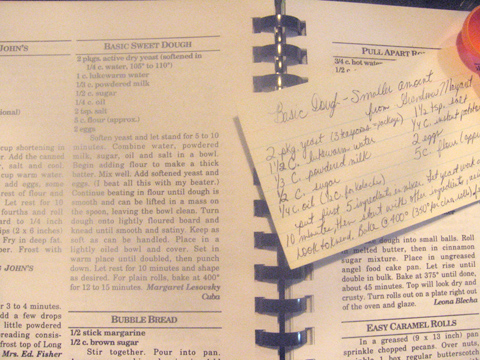
So to all my Cuba homies who have the "Blue" 1978 Cuba Presbyterian Guild Cook Book with my grandmother Margaret Lesovsky's recipe on page 118, it's been updated -- by my grandmother, who was always noting the total amount of flour and other alchemy while baking. Here's the latest version of her "basic" dough that she called her "smaller amount" that also included less kneading. My grandmother didn't think I was the world's best at kneading, but I'd not had her decades of experience either.
GRANDMA MARGARET'S
BASIC 'SWEET' DOUGH - SMALLER AMOUNT
2 packages of yeast (3 teaspoons equal a package) = 6 teaspoons of yeast
1 1/2 cups lukewarm water (water that is warm and comfortable on the wrist)
1/3 cup of powdered milk (Can you tell my Grandmother grew up in the Depression?)
1/2 cup of sugar
1/4 cup of oil (1/2 cup of oil if making kolaches)
1 1/2 teaspoons of salt
1/4 cup of instant potatoes (Depression inspired? Saves time from boiling real potatoes)
2 eggs
5 cups of flour (approximately)
Put first 5 ingredients (through oil) into mixer. Let yeast work about 10 minutes.

Then start with other ingredients, making sure you have enough flour. I of course ran out of flour and had to run to the store, hoping the yeast wouldn't expand too much. I noticed later my grandmother's wheat roll recipe calls for this "sponge" action of adding two cups of flour and waiting before adding more flour, so 20 minutes between the cups of flour didn't seem to effect the outcome. Whew!
So once you have nearly five cups of flour (preferably Hudson Cream) use the mixer's dough hook to knead. I love this part of the recipe, though I still made a mess.
 Here's where I zoned off (all those years ago) when I was writing down Grandma's recipe, perhaps because it was ALWAYS pretty warm in her kitchen. My next step says "Bake at 400 degrees" so I know I skipped a few vital instructions. Yes, I can see my grandmother shaking her head now.
According to her published recipe in the "blue" cookbook here are the rest of the dough directions:
Continue beating in flour until dough is smooth and can be lifted in a mass on the spoon, leaving the bowl clean. Turn dough onto lightly floured board and knead until smooth and satiny. (I did this for three minutes and called it good.) Keep as soft as can be handled. (I think that means not to add too much more flour.) Place in a lightly oiled bowl and cover. Set in a warm place until doubled* then punch down. Let rest for 10 minutes and shape as desired. (For plain rolls, rohliks with poppy seeds, bake at 400 degrees for 12 to 15 minutes.)
For the actual kolaches recipe, I've referred to the blue cookbook's Czech kolache notes from Mrs Ed Fisher, and used raising times from Warren Brown's kolache recipe. *Brown lets dough in bowl initially rise for 90 minutes.)
I divided the dough and started forming small rolls about the size of a small egg (thinking small because they'll continue raising with that massive amount of yeast!), placing them two inches apart.

I flattened them slightly and let them rise when they're doubled in size. (Brown specifies 30 minutes, Fisher says Kolaches can be tested by pressing in the center. If an indention remains they're ready to spread out, leaving a 1/2 inch edge. Sort of like this, I am by no means a Kolache Queen:

Fill with filling of choice — I used canned ready cherry and apricot pie fillings - puree apricot filling before using - or I make my own plum or what we used to call prune filling. I added canned pineapple to the apricot because my Grandmother always liked to make pineapple kolaches because that was her favorite fruit. There's also a poppy seed and cottage cheese option, but, yuck! I don't even attempt to make that disgusting kind.
START THIS THE NIGHT BEFORE:
Debbie's Plum Filling
1 orange (you'll need the zest)
1 package pitted plums (12 oz.)
1 1/2 cups raisins
2 Tablespoons sugar
1 teaspoon lemon juice
Soak prunes and raisins overnight in water. Cook until soft with the zest of the orange and the sugar. Drain. Add lemon juice. Puree and ready to go.

After carefully filling the centers, an egg wash is optional. They'll need to raise one last time for about 5 to 10 minutes and then can bake in a 400 degree oven for 10 to 12 minutes. Mine took about 15 minutes. Don't forget to go light on the filling:

But my first batch turned out well enough I think my Grandmother would have been proud. The total recipe made four dozen. And if you're within driving distance of my house, I've still got some to share.

I didn't really think about featuring the Kolache as Nebraska's dessert until I was browsing my newest cookbook: "United Cakes of America" by Warren Brown. This wonderful cookbook is mandatory reading for our journey. Warren, who has bake shops on the East Coast, has put together a national treasury of desserts that's also an entertaining history of baking in America. Plus, it's one of the very few cookbooks that organizes recipes by state. (So if any publishing houses want to explore this idea of more regional/state cooking themes, feel free to contact me.)
 |
| Cherry Kolaches I made on the first try after years of not making them. |
Cuba's got a strong Czech heritage and I remember once singing a happy Czech song in a skit with two other little preschool friends in front of lots of people laughing. I cannot remember WHAT we were singing, but it was probably about food. I think the older lady on stage with us had a bucket of lard. But maybe I'm getting mixed up. It was a long, long time ago. But the Senior Citizen's Community Center had a stage backdrop that was a painting of a Czech street scene. I'm not sure what condition it's in now all these years later, but there's a great photo of that backdrop if you go to Jim Richardson's Web site, click "Documentary: Our Heartland" and then click on "Cuba, Kansas."
Did you know my hometown was exotic enough to be featured in the May 2004 National Geographic? A subsequent issue printed my letter to the editor thanking photographer Jim Richardson. I'm wondering if I can technically count "National Geographic" as one of the places my work has appeared?
So to all my Cuba homies who have the "Blue" 1978 Cuba Presbyterian Guild Cook Book with my grandmother Margaret Lesovsky's recipe on page 118, it's been updated -- by my grandmother, who was always noting the total amount of flour and other alchemy while baking. Here's the latest version of her "basic" dough that she called her "smaller amount" that also included less kneading. My grandmother didn't think I was the world's best at kneading, but I'd not had her decades of experience either.
 | ||||
| The inscription in my cookbook from my grandmother. |

BASIC 'SWEET' DOUGH - SMALLER AMOUNT
2 packages of yeast (3 teaspoons equal a package) = 6 teaspoons of yeast
1 1/2 cups lukewarm water (water that is warm and comfortable on the wrist)
1/3 cup of powdered milk (Can you tell my Grandmother grew up in the Depression?)
1/2 cup of sugar
1/4 cup of oil (1/2 cup of oil if making kolaches)
1 1/2 teaspoons of salt
1/4 cup of instant potatoes (Depression inspired? Saves time from boiling real potatoes)
2 eggs
5 cups of flour (approximately)
Put first 5 ingredients (through oil) into mixer. Let yeast work about 10 minutes.

Then start with other ingredients, making sure you have enough flour. I of course ran out of flour and had to run to the store, hoping the yeast wouldn't expand too much. I noticed later my grandmother's wheat roll recipe calls for this "sponge" action of adding two cups of flour and waiting before adding more flour, so 20 minutes between the cups of flour didn't seem to effect the outcome. Whew!
So once you have nearly five cups of flour (preferably Hudson Cream) use the mixer's dough hook to knead. I love this part of the recipe, though I still made a mess.

According to her published recipe in the "blue" cookbook here are the rest of the dough directions:
Continue beating in flour until dough is smooth and can be lifted in a mass on the spoon, leaving the bowl clean. Turn dough onto lightly floured board and knead until smooth and satiny. (I did this for three minutes and called it good.) Keep as soft as can be handled. (I think that means not to add too much more flour.) Place in a lightly oiled bowl and cover. Set in a warm place until doubled* then punch down. Let rest for 10 minutes and shape as desired. (For plain rolls, rohliks with poppy seeds, bake at 400 degrees for 12 to 15 minutes.)
For the actual kolaches recipe, I've referred to the blue cookbook's Czech kolache notes from Mrs Ed Fisher, and used raising times from Warren Brown's kolache recipe. *Brown lets dough in bowl initially rise for 90 minutes.)
I divided the dough and started forming small rolls about the size of a small egg (thinking small because they'll continue raising with that massive amount of yeast!), placing them two inches apart.

I flattened them slightly and let them rise when they're doubled in size. (Brown specifies 30 minutes, Fisher says Kolaches can be tested by pressing in the center. If an indention remains they're ready to spread out, leaving a 1/2 inch edge. Sort of like this, I am by no means a Kolache Queen:

Fill with filling of choice — I used canned ready cherry and apricot pie fillings - puree apricot filling before using - or I make my own plum or what we used to call prune filling. I added canned pineapple to the apricot because my Grandmother always liked to make pineapple kolaches because that was her favorite fruit. There's also a poppy seed and cottage cheese option, but, yuck! I don't even attempt to make that disgusting kind.
START THIS THE NIGHT BEFORE:
Debbie's Plum Filling
1 orange (you'll need the zest)
1 package pitted plums (12 oz.)
1 1/2 cups raisins
2 Tablespoons sugar
1 teaspoon lemon juice
Soak prunes and raisins overnight in water. Cook until soft with the zest of the orange and the sugar. Drain. Add lemon juice. Puree and ready to go.

After carefully filling the centers, an egg wash is optional. They'll need to raise one last time for about 5 to 10 minutes and then can bake in a 400 degree oven for 10 to 12 minutes. Mine took about 15 minutes. Don't forget to go light on the filling:

But my first batch turned out well enough I think my Grandmother would have been proud. The total recipe made four dozen. And if you're within driving distance of my house, I've still got some to share.

Subscribe to:
Posts (Atom)